
Monday, 14 March 2011
If you're still following Future of Mobile Broadband...
...then you really should switch across to my new (and old) blog The Wireless Noodle. There's an interesting post on there about how delaying the award of spectrum LTE will help UK operators.

Monday, 24 January 2011
Redirecting you to the Wireless Noodle blog
A new year brings me a new job as Director at Machina Research, a specialist research and consultancy firm focusing on M2M, IoT and mobile broadband. I'm very excited about the new opportunity and there will be more announcements to come. Since my new focus will shift to cover more than just mobile broadband I thought I'd shift to a new blog: The Wireless Noodle. Actually it's an old blog that I started back in 2008, but I've decided to resurrect it.
Monday, 9 August 2010
No more here for a while...
I've been less than active in my blogging over the last few months. A busy time. Anyway, I'm not likely to be posting much for the foreseeable future as I'm heading off travelling for a while. Follow my progress at http://overlandaroundtheworld.blogspot.com/
Tuesday, 15 June 2010
Australia sees impressive improvement in MBB speeds
Interesting story from Australia the other day about average speeds delivered by mobile broadband providers. Over the last 2 years average mobile broadband download speeds have increased 68% to 2.9Mbit/s and upload speeds by 169% to 1.2Mbit/s.
This degree of improvement is impressive indeed and reinforces that mobile broadband can be a realistic alternative to DSL, particularly for users with relatively modest speed requirements.
This degree of improvement is impressive indeed and reinforces that mobile broadband can be a realistic alternative to DSL, particularly for users with relatively modest speed requirements.
Thursday, 10 June 2010
AT&T and Verizon abandon unlimited mobile data - the only sensible move
Over the last couple of weeks both Lowell McAdam of Verizon Wireless and the irrepressible Ralph de la Vega of AT&T Wireless announced plans to rein in unlimited mobile data plans. In the case of Verizon this is to coincide with the launch of LTE. For AT&T (struggling with network capacity issues now) it'll happen now. Both are planning to replace unlimited plans with a tiered approach to tariffing that will be reasonably familiar in European markets whereby users pay different amounts depending on how many GB of data they need.
Obviously there are some drawbacks to this approach. Users love unlimited plans as it takes away any fear, particularly of the dreaded overage fees. However, the availability of unlimited plans puts undue strain on the network as a result of small numbers of heavy users generating massive volumes of traffic. Last year I was in Finland and all the operators there were complaining about exactly this issue. They let the unlimited genie out of the bottle and were struggling with how to put it back in. But put it back they must.
Managing traffic growth by restricting unlimited plans is essential if MNOs are going to manage the rapidly declining revenue per GB that threatens to derail plans for deploying new network capacity. Let's face it, no-one's rolling out LTE do provide better voice coverage. It's all about data and if the MNOs can't maintain a reasonable rev/GB then regardless of LTE's benefits in terms of spectral efficiency, they won't be able to afford to deploy. Restoring a link between revenue and usage is essential.
Obviously there are some drawbacks to this approach. Users love unlimited plans as it takes away any fear, particularly of the dreaded overage fees. However, the availability of unlimited plans puts undue strain on the network as a result of small numbers of heavy users generating massive volumes of traffic. Last year I was in Finland and all the operators there were complaining about exactly this issue. They let the unlimited genie out of the bottle and were struggling with how to put it back in. But put it back they must.
Managing traffic growth by restricting unlimited plans is essential if MNOs are going to manage the rapidly declining revenue per GB that threatens to derail plans for deploying new network capacity. Let's face it, no-one's rolling out LTE do provide better voice coverage. It's all about data and if the MNOs can't maintain a reasonable rev/GB then regardless of LTE's benefits in terms of spectral efficiency, they won't be able to afford to deploy. Restoring a link between revenue and usage is essential.
Thursday, 4 March 2010
Coping with wireless traffic demand
I recently published an Insight article for Analysys Mason based on some of the research I was doing at Mobile World Congress. My focus this year was on wireless traffic growth and how MNOs could deal with it. Below are a brief summary of the findings. Full version here.
A major focus of Mobile World Congress (MWC) 2010 was the seemingly inexorable and exponential growth in wireless data traffic. This is exemplified by the growth in Vodafone’s European data traffic: a 300% increase over the last two years. There have been even more substantial localised spikes: O2 UK, for instance, experienced a twentyfold increase in data traffic during 2009, and Hong Kong’s CSL saw a fourteenfold increase in traffic in the nine months after the deployment of HSPA, in March 2009.
Given this trend, vendors at MWC outdid each other in predicting traffic growth over the next five years: Cisco claimed that global data traffic will increase by a factor of 39 between 2009 and 2014, while Ericsson predicted fiftyfold growth by 2015. NSN plumped for forecasting an equally round, but rather more ambitious, hundredfold rise. Analysys Mason is currently working on its own forecast of global traffic, which will be published in April. The consensus within the industry is that there will be substantial growth in demand for wireless traffic over the next five years.
A successful strategy for dealing with this exponential growth in wireless data traffic has four pillars, each of which is necessary, but is itself insufficient to deal with the demand.
- Spectrum: a scarce resource. Currently, MNOs rely on a relatively small piece of spectrum to provide data services. In Europe, for instance, 3G uses a total of 150MHz in the 2.1GHz band. Similar constraints apply in other regions. Large chunks of additional spectrum at 800MHz and 2.6GHz are soon to become available and MNOs are looking to refarm 900MHz spectrum to use for 3G. In the next five years in Europe, the total available spectrum for 3G and 4G will increase from 150MHz to 470MHz, which is a 200% increase in capacity. See here for more explanation.
- Technology choices: HSPA+, LTE, MIMO and beyond. The availability of capacity does not, of course, rest solely on what spectrum is obtainable. It also depends on the technology that is used. As MNOs upgrade to HSPA+ and LTE, they will be able to squeeze more capacity out of their spectrum. The addition of features such as MIMO and multiple carriers brings significant benefits. Compared with the existing 14.4Mbit/s HSPA that is fairly common in developed 3GPP markets today, LTE offers approximately three times the capacity (assuming the same amount of spectrum). For more, see here.
- In-building coverage: femtocell or repeater? Analysys Mason anticipates that by 2016, over 80% of global wireless data traffic will be generated indoors. It is critical to MNOs’ success that they offload this traffic from the wireless macro network. Today, much indoor usage, particularly that of PC-based mobile broadband, is already offloaded and MNOs must ensure that this trend continues. Evidence from Analysys Mason’s consumer survey shows that most mobile broadband usage takes place in the home and other recent analysis (our Comment article "What the Nordic markets can tell us about fixed-mobile broadband substitution" indicates that mobile broadband is becoming a true substitute for DSL. As in-building traffic increases, so will the requirement to offload it from the macro network. The femtocell is the most obvious technology to use to offload this traffic. Wi-Fi could achieve similar objectives, but its long-term success is in question because it uses unlicensed spectrum. Also, there are more-effective ways of delivering in-building capacity using solely the macro network. Delivering in-building traffic places up to three times as much strain on the network as the equivalent volume of outdoor traffic (see Analysys Mason Comment "Is indoor coverage good enough for mobile broadband?"). MNOs can significantly improve performance if they can make the provision of in-building bandwidth more closely resemble that of outdoor bandwidth. This can be achieved using repeaters, which can be strategically placed close to windows.
- Traffic, policy and subscriber management: making the users pay. The most important thing that MNOs can do to ensure the future profitability of their networks is effectively to manage their subscriber bases and the traffic that these generate. Figures vary, but MNOs are finding that, typically, 80% of wireless data traffic is generated by 5–10% of their subscribers. This is not a problem as long as those who are consuming the data are paying for it. This is often not the case, particularly where MNOs offer tariffs that include unmetered access. Operators that have chosen to offer unlimited plans are now regretting this. It is critical for future network upgrades that MNOs do not allow subscribers to consume bandwidth without generating commensurate revenue. If they are able to control this successfully, it will either reduce network load or ensure that their margin per gigabyte increases substantially. This will either lessen the need for expensive network upgrades or provide the cash to undertake them.
A combination of acquisition of new spectrum and deployment of LTE will increase network capacity to nine times what it is now. However, this will be expensive and it will not be sufficient to meet bandwidth demand. In order to meet the demand for data traffic cost-effectively in the next five years, MNOs must focus on halting the growth of in-building macro network traffic by using femtocell or repeater technology and on managing the demand for bandwidth by curbing the excesses of their heavy users.
Following up on this exercise, we'll be doing a lot of work looking at scenarios for coping with bandwidth demand and what strategies MNOs need to adopt. This will be based on a modelling exercise that looks at both the demand and supply elements of supporting wireless data traffic. The aim is to stitch the two sides together. Watch this space. Or drop me a line if you're interested.Thursday, 7 January 2010
Recession drives down mobile ARPU
I've just been doing a little analysis of the impact of the recession on mobile ARPU in Western Europe. It's interesting to compare ARPU at Q2 2009 with those at Q2 2008 (when we were just on the cusp of recession) and Q2 2007 when everything in the garden was still rosy!
Based on a rough average across all the markets, blended ARPU fell 10% between Q2 2008 and Q2 2009, compared to a decline of just 6% in the previous 2 years. The most prominent decline has been in prepaid ARPU which fell 12% in the period, compared to just 9% in the previous 12 months. Contract saw a 9% fall, compared to 8% in the previous year.
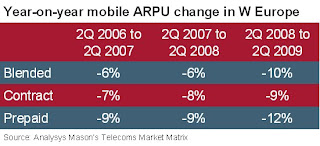
Based on a rough average across all the markets, blended ARPU fell 10% between Q2 2008 and Q2 2009, compared to a decline of just 6% in the previous 2 years. The most prominent decline has been in prepaid ARPU which fell 12% in the period, compared to just 9% in the previous 12 months. Contract saw a 9% fall, compared to 8% in the previous year.

So prepaid seems to have taken the brunt of the recession. In some ways that's unsurprising. Contract users are tied in with a guaranteed minimum spend for the duration of their contract. So any decline in ARPU will be slower to materialise. So it will be worth keeping an eye on over the next 12 months. The decline in prepaid is more immediate as users can instantly influence their spending and reduce it as necessary. They are also the most immediate recipients of any price discounts that operators choose to hand out.
This is all based on the marvellous data collected for Analysys Mason's Telecoms Market Matrix, the finest source of quarterly quantitative telco data that you can lay your hands on, covering both fixed and mobile markets in Western Europe and Central & Eastern Europe.Thursday, 31 December 2009
Orange hopes for halo effect from launching HD voice
 Orange UK has announced that it will be launching high definition (HD) voice, using the Wideband Adaptive Multi-Rade (WB-AMR) codec. Full nationwide roll-out will follow in 2010, as will compatible devices. Press release here.
Mobile operators have been flirting with high quality voice services for years but I'm healthily sceptical about demand. Clearly, with 70%+ of revenue coming from voice, Orange and other operators need to explore ways to differentiate that service. But HD voice isn't the way to do it. Users won't pay more for it and mobile operators should be looking at reducing, not increasing, the load on their networks.
The migration of traffic from traditional fixed line, where quality is best, to mobile and VoIP services (such as Skype) shows that sound quality is really a fairly minor issue for most users. Price and convenience are much more important. It's also interesting that having perfect clarity on telephone calls has proven to actually be disconcerting for users. If lines are too quiet, network operators insert artificial background noise (Comfort Noise Insertion) when the other party is not speaking so the caller knows they haven't hung up.
So if no-one cares and no-one's going to pay, why do this? PR. This is surely another way for Orange to continue banging on about the superiority of their network. Whether or not their network is superior (and for the average punter it's completely opaque) it's vitally important to have a message that yours is best. The concept of HD is linked to superior user experience, so this announcement is all about the halo effect. Surely Orange isn't expecting anyone to pay extra to take HD voice. In a world where no-one knows who has the best network, but network superiority is a good differentiator, it's critical to find ways to communicate how much better your network is. Being cynical for a moment, perhaps HD voice is one way of doing that.
Tuesday, 29 December 2009
Mobile broadband in Saudi Arabia: Mobily pass 1m subs but average usage only 50MB/month
 I just saw this report that Saudi mobile operator Mobily had just reached 1m mobile broadband customers. In a country of 30m people that's an impressive feat. Furthermore that represents a four-fold increase (almost) on the subs base at the end of 2008. Tariffs aren't cheap either, with the cheapest option costing USD27/month for 1GB, up to USD94/month for an unlimited bundle.
Usage levels seem to be relatively low. According to the Zawya report, traffic for December 2009 stood at 50 terabytes, which equates to just 50MB per user. So either there are lots of inactive users or internet usage is very light in KSA, which would indicate that the vast majority of users are on the lowest tariff and there is very little use of peer-to-peer file sharing.
Monday, 21 December 2009
Retaining mobile broadband customers: it's all about inertia
Analysys Mason has just published a report looking at the thorny issue of churn management in mobile broadband. MNOs must put retention at the core of their mobile broadband strategy looks at the customer retention and churn reduction strategies that MNOs must pursue to be as effective as possible at retaining subscribers. In a nutshell it's all about recognising the importance of inertia (of which there's a lot) and looking for genuine customer acquisition opportunities (which have to be sought out).
This report was put together on the back of work done on retention and churn reduction in the mobile world in general. See here for more details.
Also published recently was Strategies for mobile broadband in CALA: forecasts and analysis 2009–2014, which focuses on the Caribbean and Latin American markets where mobile broadband threatens to be a real threat to DSL infrastructure and revenue opportunities are substantial.
Both excellent reads and I thoroughly recommend them.
This report was put together on the back of work done on retention and churn reduction in the mobile world in general. See here for more details.
Also published recently was Strategies for mobile broadband in CALA: forecasts and analysis 2009–2014, which focuses on the Caribbean and Latin American markets where mobile broadband threatens to be a real threat to DSL infrastructure and revenue opportunities are substantial.
Both excellent reads and I thoroughly recommend them.
Friday, 18 December 2009
France finally awards 3G licence to...Free
DSL service provider Iliad has finally been allocated France's fourth 3G licence. As the only applicant for the licence it was a fait accompli that they'd get it, but it's nice to finally get confirmation. Free Mobile (as the new operator will be known) will get the license in January 2010.
The implications? A shake up of a pretty stagnant mobile market and a particular focus on mobile broadband. They are a very strong #2 fixed broadband player (19% market share) behind incumbent France Telecom and they have a real opportunity to cross-sell mobile broadband services. This is particularly true given the established network of shared WiFi hotspots that Iliad has. There are 3 million households with Freeboxes which provide both private and public WiFi access, so Free Mobile effectively already has 3 million basestations. How they exploit this advantage will be the determining factor for how successful Free Mobile will be.
SFR has recent made such a move targeting their NeufWiFi subscribers. For analysis of that see here.
The implications? A shake up of a pretty stagnant mobile market and a particular focus on mobile broadband. They are a very strong #2 fixed broadband player (19% market share) behind incumbent France Telecom and they have a real opportunity to cross-sell mobile broadband services. This is particularly true given the established network of shared WiFi hotspots that Iliad has. There are 3 million households with Freeboxes which provide both private and public WiFi access, so Free Mobile effectively already has 3 million basestations. How they exploit this advantage will be the determining factor for how successful Free Mobile will be.
SFR has recent made such a move targeting their NeufWiFi subscribers. For analysis of that see here.
Tuesday, 1 December 2009
3 admits that mobile broadband can't meet user demand for video
Interesting to see this article about 3's concessions to people who have suffered poor mobile broadband services. Clearly, given the nature of MBB coverage, the service won't be suitable for some customers. Try-before-you-buy and no-quibbles money back guarantees should be a fixture in any operator's MBB offering.
What caught my eye though, was comments from Hugh Davies that mobile broadband was never intended for video downloading and streaming. A quick look at their website also shows that they're now stating that for video usage, fixed is best. The implication being that MBB is, and will remain, a complement rather than a replacement to DSL. If MBB can't meet user demand for video usage now, it's unlikely to be able to do so in the future. Usage will probably grow faster than supply.
Of course, I have always maintained that MBB is a complement to fixed (see here) but it's particularly interesting to see a mobile-only player admit that a subscriber's broadband needs can't be met by mobile!

What caught my eye though, was comments from Hugh Davies that mobile broadband was never intended for video downloading and streaming. A quick look at their website also shows that they're now stating that for video usage, fixed is best. The implication being that MBB is, and will remain, a complement rather than a replacement to DSL. If MBB can't meet user demand for video usage now, it's unlikely to be able to do so in the future. Usage will probably grow faster than supply.
Of course, I have always maintained that MBB is a complement to fixed (see here) but it's particularly interesting to see a mobile-only player admit that a subscriber's broadband needs can't be met by mobile!
Friday, 6 November 2009
Orange bigs up network as the iPhone looms
 Orange is gearing up for their launch of the iPhone in the UK with a very sensible campaign based on network coverage (see right hand side of the graphic above). They have correctly identified that their big differentiator from O2's iPhone will be network coverage where they outstrip the former exclusive rights holder.
 I doubt that O2 will be too badly burnt by the end of exclusivity. The difference between iPhone and no iPhone is substantially more than iPhone vs iPhone with slightly better coverage. There is very high inertia in the UK market and there probably won't be much impact on O2, other than the fact that they'll have to start sharing new converts to the iPhone with Orange, and soon Vodafone. That said high ARPU subscribers generally have a higher churn rate than average, so iPhone users will probably be less inert than the average. Nevertheless I think the risk to O2's existing iPhone base is modest.
I've been looking at the issues of retention and churn in some detail in a report that is soon to be published called Mobile customer retention and churn management.
Monday, 26 October 2009
Comes With Music sees very limited adoption
Music Ally recently published on its blog figures for Nokia Comes With Music adoption. A grand total of 107,000 users worldwide. In the UK after 12 months the total figure was a disappointing 33,000. Hardly tearing up trees but spectacular success compare with Italy where after 6 months in service there were only 691 users.
Mind you, given my experience of using CWM (yes, I am/was a user), I am not terrifically surprised. If the word of mouth reflects the user-friendliness (or lack of it) of the service then it's hardly surprising that people aren't signing up in their droves. Sounds too good to be true? With that clunky DRM, it is.
Mind you, given my experience of using CWM (yes, I am/was a user), I am not terrifically surprised. If the word of mouth reflects the user-friendliness (or lack of it) of the service then it's hardly surprising that people aren't signing up in their droves. Sounds too good to be true? With that clunky DRM, it is.
Ericsson estimates 1GB = €1
Apologies for the radio silence over the last 2 weeks. I've been on vacation in Jordan, which was spectacular. No mobile broadband-related anecdotes I'm afraid as I didn't go anywhere near any broadband connections for the whole time I was there. Clearly the mobile phone is absolutely critical to businesses there though. It was quite surreal sitting in the desert at Wadi Rum listening to the Bedouin guides taking calls from people wanting to book themselves onto tours. Anyway, I disgress.
The interesting thing that I missed during my absence was this report from Ericsson on the cost of deploying mobile broadband. The long and short of it is that they reckon that it costs less than €1 to provide 1GB of data. Obviously there's a whole host of assumptions in there. If you're interested, take a look at the original document. This clearly has implications for pricing of mobile broadband. My assumption was that MNOs were getting pretty close to marginal cost as it is. Looks like they have quite some way to go yet.
The interesting thing that I missed during my absence was this report from Ericsson on the cost of deploying mobile broadband. The long and short of it is that they reckon that it costs less than €1 to provide 1GB of data. Obviously there's a whole host of assumptions in there. If you're interested, take a look at the original document. This clearly has implications for pricing of mobile broadband. My assumption was that MNOs were getting pretty close to marginal cost as it is. Looks like they have quite some way to go yet.
Friday, 9 October 2009
Gym babes: the iPhone killer app
Couldn't help but laugh when I saw this. Gym babes! It's the killer app for the iPhone.
Thursday, 1 October 2009
Ranking countries by Broadband Leadership
Fascinating report put out by the Said Business School and Cisco looking at which countries are ready for the broadband future and which...ahem...aren't. South Korea beat last year's leader Japan into second place. Sweden, Switzerland and Netherlands are Europe's leaders. Yokohama, Nagoya and (curiously) Vilnius, Lithuania were the top 3 cities. Check out the report. Makes for interesting reading.
Wednesday, 23 September 2009
Still thinking handset-as-a-modem will be big? Think again.
I keep hearing arguments in favour of handset-as-a-modem as a major device form factor of choice but I remain sceptical, for six main reasons:
- Laptops will increasingly come with HSPA module as standard. So, where's the market for a peripheral device of any sort?
- Handset manufacturers are hardly likely to start pushing their device as a dumb modem. Sure, if you're committed enough to finding a way to use it as a modem, you will, but it's not mass market.
- It won't provide as good an experience. Handsets will lag modems in terms of transmission speed. Probably not a critical issue for most people, but relevant.
- It's in the interests of the MNO to sell 2 devices. Why sell an add-on when you can sell a whole new 18m contract or dedicated prepay device which has its own credit?
- People mostly don't go for devices that can do everything. Who needs a phone, blackberry, MP3 player AND camera when your phone can do it all? No-one. Who has actually gone the whole hog and dumped all those separates? No-one, pretty much.
- You can't share your phone. You can share your modem. There's no way I'd leave my phone at home for my other half to use when she's working from home, but I'm happy to do that with the broadband. OK, so you also can't share an embedded modem, but that's another issue entirely.
If you want to know more, see the following report I wrote a few months ago - Mobile broadband devices: from USB modems to where?
Tuesday, 22 September 2009
Thoughts from Informa's Mobile Pricing, Retention and Loyalty Conference
I'm co-chairing a breakfast briefing at the Informa Mobile Pricing, Retention and Loyalty Conference in Oxford tomorrow, so I came up for the second day today. A few interesting issues cropped up:
- Dynamic tariffing - The idea of charging according to network loading is a logical one, particularly in price sensitive markets. It allows for a great segmentation of subscribers into those who are willing to pay (e.g. business users) who will make the call regardless of price, and those who aren't, who will wait for cheap prices when the network is less heavily loaded. This is also applicable to mobile broadband, allowing that differentiation of business and consumer users which is critical.
- Bundling of fixed and mobile broadband is vital even in low DSL penetration markets. We heard from an operator in Turkey, where DSL penetration is relatively low and even there the focus of MBB is on bundling it with DSL and public WiFi, provided by partner networks.
- If you're going ot indulge in a price war, do it via a secondary brand. This allows some differentiation, even if it's artificial and the service is broadly the same.
- Attract the customers you want to retain. Most people have low utilisation. Those P2P file sharers who generate all the traffic have very high utilisation and compromise the potential profitability of mobile broadband. Therefore MNOs should avoid acquiring these customers. Try to get the peer-to-peer file sharer to go elsewhere. So don't be the cheapest.
Interesting stuff.
Monday, 21 September 2009
Free report on LTE from the UMTS Forum
Interesting new report published on the UMTS Forum looking at the LTE ecosystem. To be partisan for a moment, obviously it would have been miles better if it have been put together by Analysys Mason. Nevertheless Ovum make a reasonable fist of it.
Find it here.
For the definitive view on LTE evolution, see our report Operator strategies for network evolution: the road to LTE.
Find it here.
For the definitive view on LTE evolution, see our report Operator strategies for network evolution: the road to LTE.
Subscribe to:
Posts (Atom)


 Posts
Posts


